Introduction
Ambulance red light rules..
Flashing blue lights appear behind you, so you move quickly—but one well-intentioned mistake could mean three penalty points and a fine.
In this guide, we explain:
- What to do when an ambulance approaches
- Whether you can cross a red light
- Where and when you should pull over
- Which dangerous reactions drivers must avoid
- How a traffic offence could affect your car insurance
- Why staying calm may protect both your licence and your wallet
What Should You Do When An Ambulance Approaches?
Most drivers instinctively want to clear the road as quickly as possible.
That reaction makes sense.
However, speed is not the priority.
Safety is.
Highway Code Rule 219 tells drivers to consider the emergency vehicle’s route and take appropriate action while obeying traffic signs. (GOV.UK)
In other words, you should help the ambulance pass without creating another dangerous situation.
Ambulance Red Light Rules: Here Is The Crucial Point
The ambulance driver needs you to act predictably, not dramatically.
First, check your mirrors and assess the road ahead.
Then, look for somewhere safe to pull over without blocking a junction, bend or narrow section.
Signal clearly before changing your position.
Afterwards, slow down gradually and leave enough space for the emergency vehicle to pass.
Avoid braking sharply.
A driver behind you may not have seen the ambulance yet.
Likewise, do not stop in the middle of the road unless traffic conditions leave no safer alternative.
You could block the ambulance rather than help it.
And there is another risk
Some drivers panic and mount the kerb.
However, doing so could endanger pedestrians, damage the vehicle or cause a collision.
The Highway Code specifically advises drivers not to endanger themselves, pedestrians or other road users when making space.
Therefore, stay controlled and keep observing your surroundings.
Finding cheap car insurance matters, but protecting your driving record matters too.
One rushed decision can carry consequences long after the ambulance has passed.
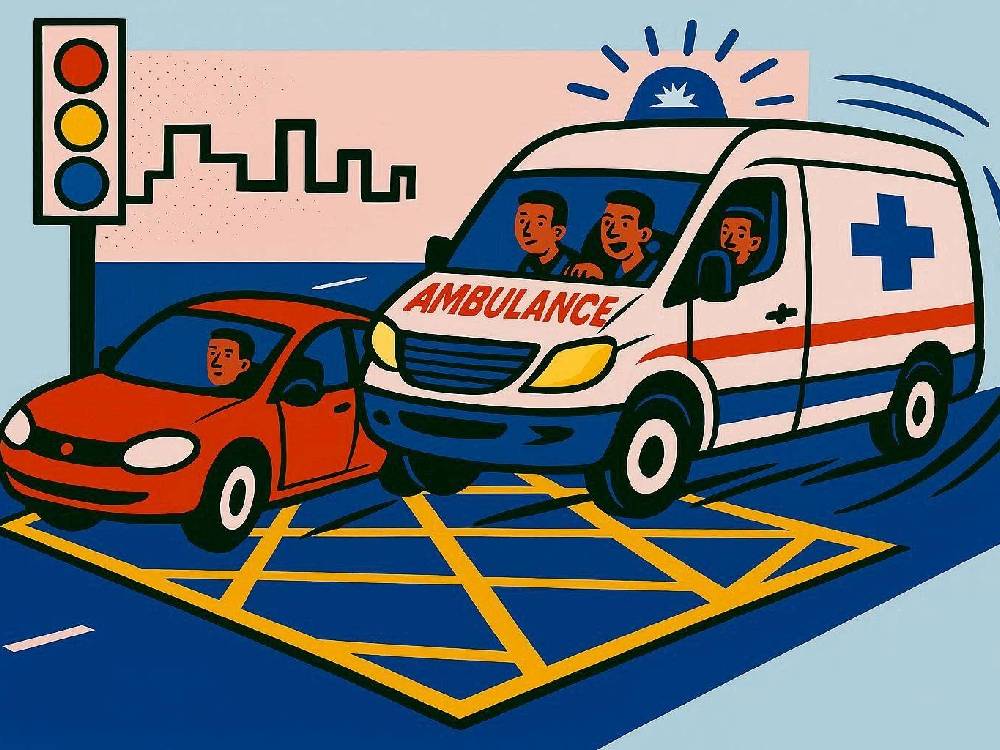
Ambulance Red Light Rules: Can You Go Through A Red Light For An Ambulance?
No.
You should not cross the solid white stop line while the traffic signal remains red.
This rule still applies when an ambulance, police car or fire engine waits behind you.
Blue Light Aware advises the first driver in a queue to remain where they are and let the emergency vehicle find another route. That May Feel Completely Wrong
You can hear the siren.
Can see the flashing lights.
You may even feel pressure to move.
Nevertheless, crossing the line could place you directly in the path of pedestrians or traffic entering from another direction.
The emergency driver understands this.
Emergency crews receive specialist training and can use legal exemptions that ordinary motorists cannot use.
Therefore, let the crew decide how to navigate the junction.
Do not enter the junction, edge across the line or move into crossing traffic.
The only clear exception arises when a uniformed police officer directs you to move.
Drivers must follow lawful directions from police officers controlling traffic.
What happens If You Go Through A Red Light For An Ambulance?
Failing to comply with traffic-light signals carries three penalty points.
A court can also impose a maximum fine of £1,000 and may consider disqualification. (GOV.UK)
That does not mean every driver will automatically receive a £1,000 bill.
However, the potential penalty remains serious.
A camera records your vehicle crossing the line.
It does not automatically know that an ambulance was behind you.
Furthermore, points on your licence may affect future car insurance options.
Insurers calculate premiums using numerous risk factors, including driving history and motoring convictions.
Consequently, a moment of panic could make finding the cheapest car insurance more difficult later.
What If The Ambulance Remains Directly Behind You?
Stay calm and remain predictable.
Do not assume that a sounding siren gives you permission to break road rules.
This is where many drivers make the mistake.
They focus entirely on the ambulance and stop watching pedestrians, cyclists and surrounding traffic.
Instead, keep checking every direction.
If the lights change to green, move forward carefully and create space as soon as conditions allow.
If they remain red, stay behind the stop line.
The ambulance may use another lane, move around the traffic or wait until the junction becomes safe.
Although the delay may feel uncomfortable, an unsafe manoeuvre could waste more time.
Worse still, it could cause another emergency.
Drivers searching for very cheap car insurance should remember that avoiding offences remains one of the simplest ways to protect their record.
Ultimately, helping an ambulance does not mean moving at any cost.
It means responding safely, legally and without panic.
**H2 Conclusion
Can You Go Through A Red Light For An Ambulance At A Junction Box?
An approaching ambulance does not cancel yellow box junction rules.
You should only enter when your exit is clear.
Otherwise, you may become trapped inside the box.
And that creates a bigger problem.
Instead of helping the ambulance, you could block its route completely.
The usual right-turn exception still applies.
However, you must only wait when oncoming traffic or another right-turning vehicle prevents you from completing the turn.
Do not follow the vehicle ahead without checking the available space.
Likewise, never enter simply because another driver behind you starts sounding their horn.
Their impatience will not protect you from a penalty.
Can You Use A Bus Lane Or Mount The Kerb?
Drivers sometimes move into a bus lane when blue lights appear behind them.
However, you should not enter a restricted lane unless the signs allow your vehicle to use it.
Bus lanes often contain cameras.
Therefore, entering one at the wrong time could result in a Penalty Charge Notice.
But that is not the only danger.
Cyclists, motorcyclists and buses may already be using the lane.
A sudden movement could cause a serious collision.
Mounting the kerb creates similar risks.
Pedestrians may not expect a car to move onto the pavement, even during an emergency.
Stay on the road and move aside only when it is safe.
A calm response protects everyone.
Ambulance Red Light Rules: How Much Could The Mistake Cost?
The penalty depends on the rule you break.
Crossing a red light can lead to three penalty points and a fine.
A court may impose a maximum fine of £1,000.
Yellow box and bus lane offences usually involve council-issued penalties instead.
However, charges vary between local authorities.
More serious manoeuvres could also lead to allegations of careless or dangerous driving.
Here is why that matters.
The immediate fine may not represent the full cost.
Penalty points and motoring convictions can also influence future car insurance prices.
Insurers consider your driving history when assessing risk.
Consequently, a rushed decision could make finding cheap insurance in the UK more difficult.
You must also answer your insurer’s questions honestly.
Failing to declare requested information could create problems later, particularly when making a claim.
What Do Silent Blue Lights Mean?
An ambulance may sometimes display blue lights without using its siren.
That does not necessarily mean the emergency has ended.
The crew may reduce noise near vulnerable road users, during quieter hours or when traffic cannot safely move.
Therefore, continue watching the vehicle.
Do not make a sudden manoeuvre simply because the siren stops.
The safest approach remains the same.
Stay alert, remain predictable and create space when conditions allow.
Five steps to remember
- Stay calm and check your mirrors.
- Identify where the emergency vehicle needs to go.
- Signal before changing speed or position.
- Obey red lights, road markings and restricted lanes.
- Move aside only when it is safe and legal.
Frequently asked questions
Do I legally have to move for an ambulance?
You should take appropriate action to help it pass while continuing to follow traffic laws.
Can you go through a red light for an ambulance?
No.
Remain behind the stop line unless a uniformed police officer directs you to move.
Will penalty points increase my insurance?
They may.
The effect depends on the offence, your driving history and the insurer’s pricing rules.
Comparing providers may help you find the cheapest car insurance available for your circumstances.
Conclusion
Stay calm and protect your licence.
Most drivers want to help emergency crews reach their destination quickly.
However, panic can turn good intentions into an expensive mistake.
Do not cross a red light, enter a blocked junction or endanger pedestrians.
Instead, stay calm and let the emergency driver choose the safest route.
One careful decision could protect your licence, your insurance premium and everyone around you.